

intro
The Terroir and the Method
The Wines: Tasting, Serving and Matching

Genius loci

01Alta Langa Terroir
02Poetry
03Farm rituals
04Women and Cuisine
Countryside Imaginary. Rites and Legends of the High Hills
Countryside Imaginary. Rites and Legends of the High Hills
From an essay byPiercarlo Grimaldi
Introduction
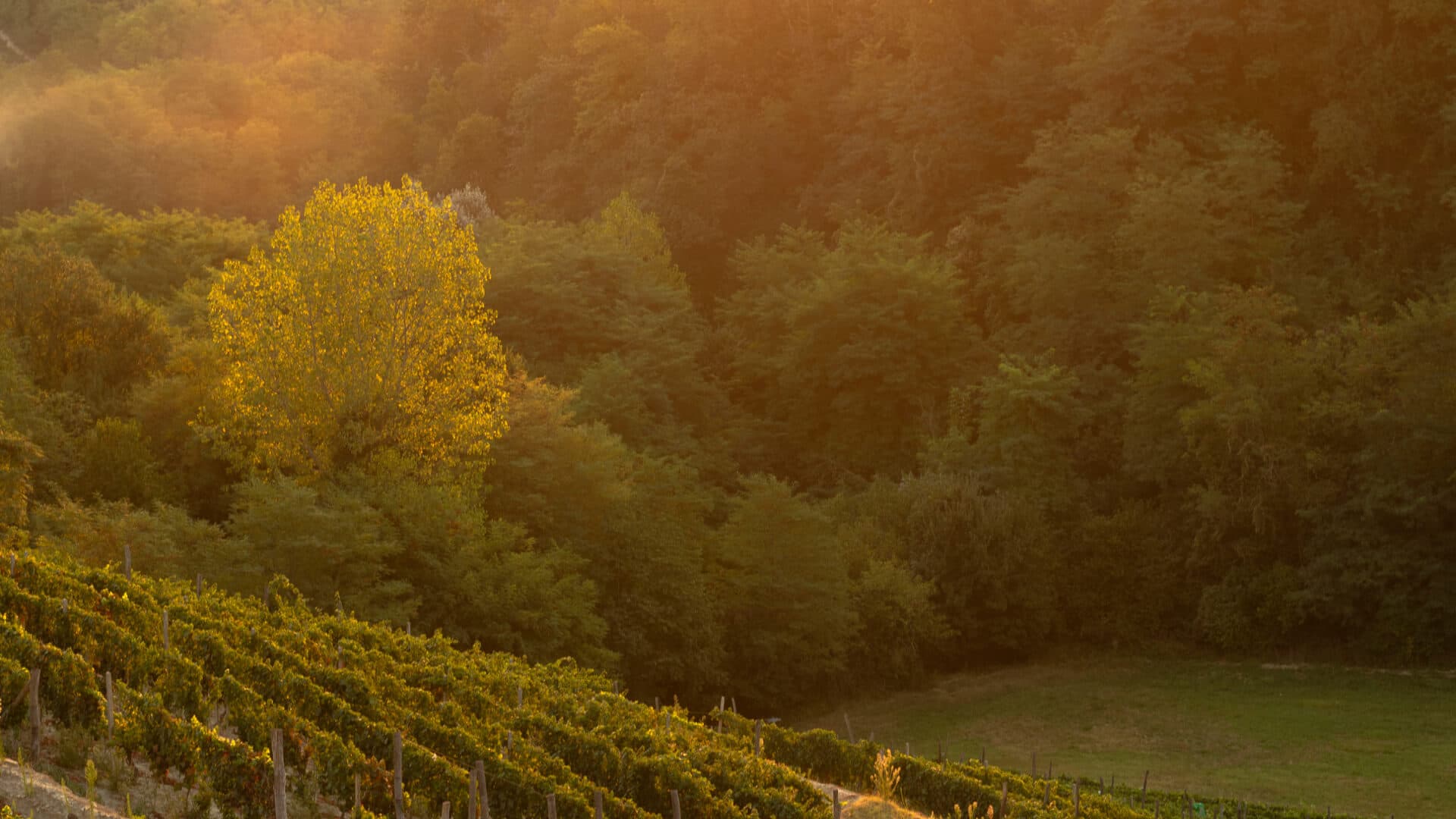
The high hills that mark southern Piedmont – Langhe, Monferrato and Roero – still preserve a traditional narrative that goes beyond history and sinks its roots deeply in the legends and rituals of the earth.
It is a tangible and intangible legacy, consisting of gestures and words, that the people of our hills have handed down from one generation to the next, all the way to the present day.
It is essential to carry out in-depth research that will bring to light what remains of the oral and gestural tradition and know-how of the high hill folk, so as to provide a critical and original picture of the farmer’s calendar of rituals, of the legends and rites that still mark feast days and work days.
This is a fundamental intangible resource for valorizing the work of fieldhands and farmers.
After the vineyards of southern Piedmont were recognized as intangible World Heritage Sites by UNESCO, a debate arose on how the Langhe became an exemplary model of development for the bordering historical areas – Asti, Monferrato and Roero – less active and proactive in this contemporary, original thrust towards the future, which has survived the hard times and looks to tomorrow with renewed confidence.
Today there is an increasingly evident desire to devise a project that will bring together the countryside created by long-vanished seas, united by nature but sometimes divided by man’s misguided anthropization. There is work to be done before this vast sea of hills is perceived and experienced as a single, indivisible, fertile land that is the birthplace of excellent products, grapes and wines.
A legacy of crops and culture that grows to the extent that it increasingly underscores its unitary nature, defined by shared ideals, practices and forms of human communal cooperation.
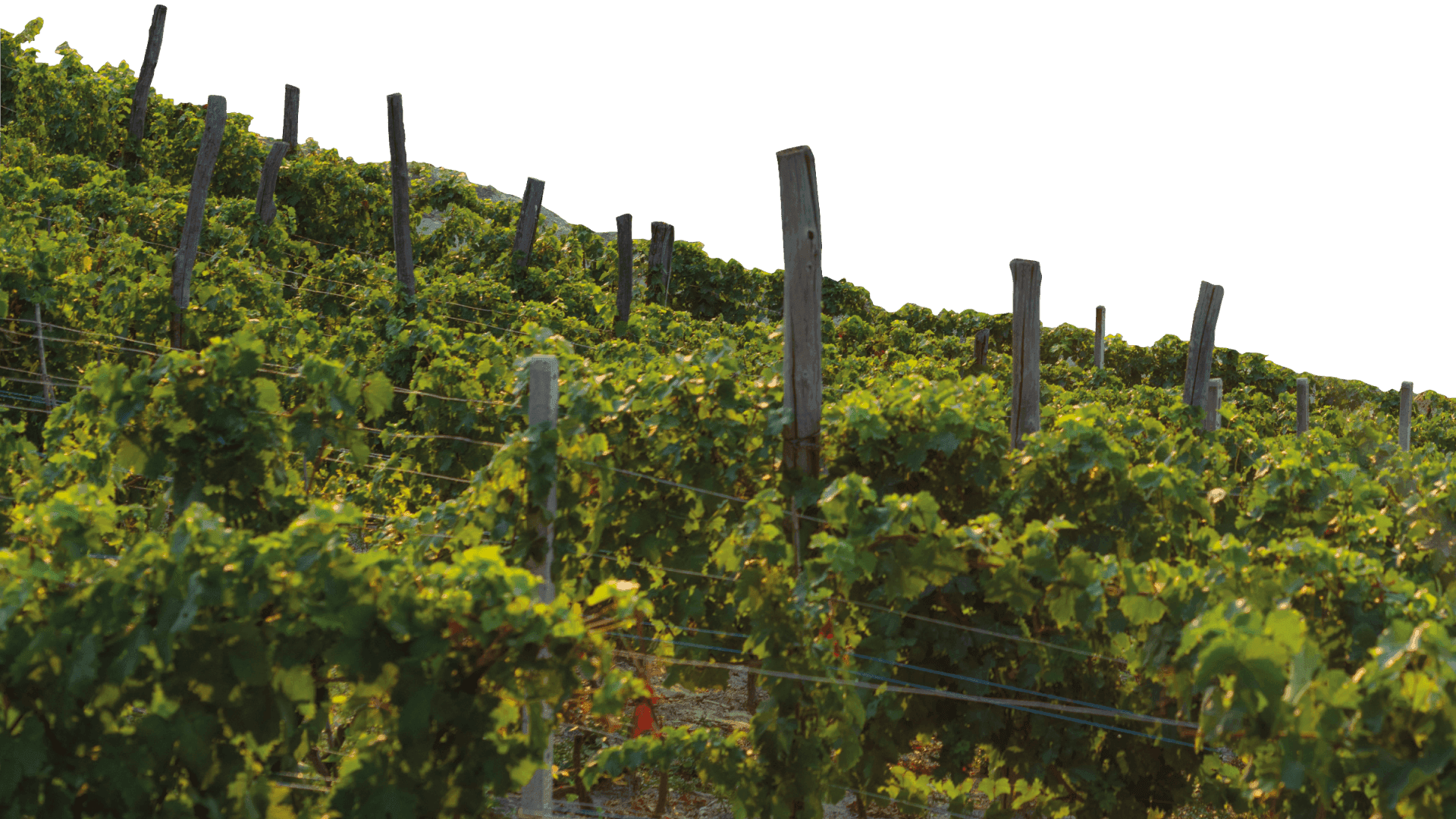
The Lands of the Consorzio Alta Langa
For some years now, the extraordinary landscape of the high hills has been adding new chapters to its story. The contract stipulated with the land, which obligates the Consorzio to protect the territory handed down to us by our ancestors, must form the foundation of an inherited anthropic development, informed and civil, that finds in the past the logical and affective basis for imagining the future.
The unsettling increase in temperatures has made possible a surprising new viticulture, which combs the high hills for vineyards that can host original wines.
The research project conducted by the Consorzio Alta Langa aims to provide realistic indications for a rebirth of the two areas, which cannot live without each other, and is dedicated to resolving this structural and cultural divide.
The Consorzio Alta Langa, which is carrying out a sustainable viticulture in harmony with the delicate biodiverse fabric of these hills, intends to commit to a pact of mutual trust and honesty and contribute to protecting the high hills and their ethos, in keeping with the changing of the seasons and the regenerating moons. A pact aimed at recovering the ritual rhythms of the farm worker’s calendar.
Tourism, starting in the 1970s, has definitely created a few problems in these hills. Roaming freely through the farmlands was a privilege that depended on when the crops were ready to be harvested, during which times people were not allowed to walk through the fields.
Living in and Experiencing Tradition
On living in and experiencing the traditions of these hills we have an essential ethnographic document, collected over two decades for the Italian farming community by the scholar Paul Scheuermeier (1980). In Piedmont, the study extended over more than a decade, from 1921 to 1932, bringing to light and reconstructing a vast amount of linguistic and ethnographic material from every part of the region.
Conditions in the country could be very harsh, and survival was hard. The Swiss researcher photographed caves used as barns and storage sheds for farm equipment. Using these indications as a starting point, we were able to locate other places, refuges, caves and shelters dug into the stone that served as living quarters, or sometimes as extensions of a farmstead, places to keep animals or tools and to cellar wine.
Over the past few years I have conducted interviews, mostly with older people who had lived all their lives in the countryside and had engaged only in agriculture, unlike many others of their peers, who had instead known city life as well.
Country life without interruption, either in terms of production processes or lifestyle, according to values that seem to be preserved and to evolve organically and functionally from past experience, so much so that for some decades now they have nurtured a widespread viticulture of excellence, that has imposed itself in the world’s most prestigious markets.
An economy based on renowned, unique local agricultural products that underpin a naif, elemental cuisine.
Today, according to the last census, only three percent of the total workforce still works in the fields.
Since the seventies I have conducted constant basic research, aimed mostly at recovering and analyzing the rites, legends, celebrations and ceremonies that mark the passing of time in the traditional calendar.
I began with my birthplace, the Langhe, then expanded to the hills of southern Piedmont and then further, to include the entire region, particularly the Alpine range.
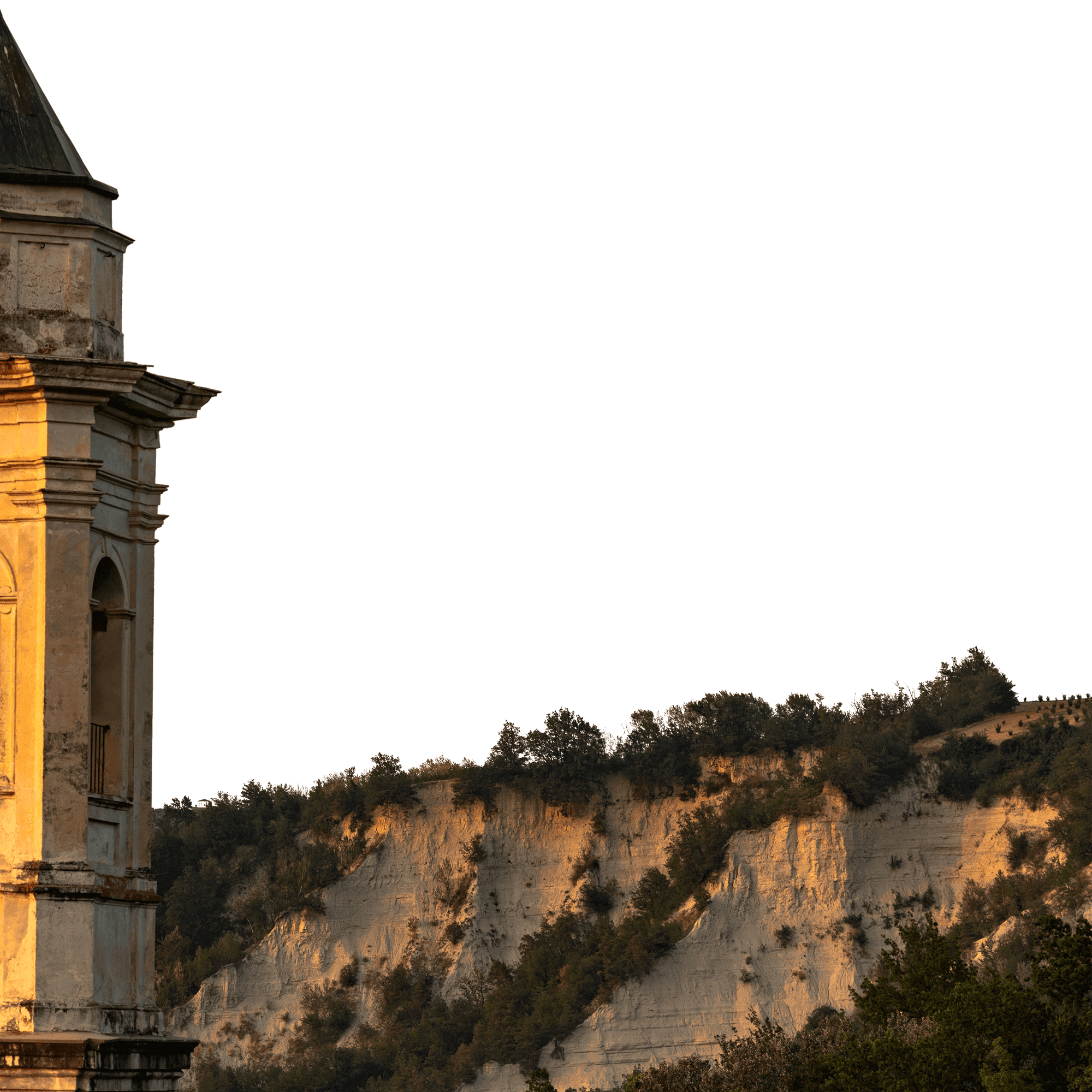
Universal Poetry in a Clump of Hills

Cesare Pavese

Beppe Fenoglio
Cesare Pavese and Beppe Fenoglio are the two authors who wrote universal poetry about our hills. Augusto Monti was a member of the previous generation who, starting in 1929, published the saga of a family from Langhe on the banks of the Bormida: his family.
Monti and Pavese left the hills in search of an intellectual modernity that only the city seemed able to provide. They lived their professional lives in Turin, and their origins turned into fertile memories of a legendary place they carried with them in their hearts forever, but which also tormented their souls.
The contrast between urban and rural permeates and nourishes their literary output. A literary and existential clash that Pavese never resolved. Monti, on the other hand, writes love songs to his wild borderlands. Paeans that ring even truer today.
Beppe Fenoglio spent his brief life in the Langhe, at Alba, in search of the highlands and the roots of his ancestors.
The poetic assembly would not be complete without the brothers Giorgio and Paolo Conte, authors of music and songs that keep charming the world. Their opus would not be as mesmerizing were it not the result of a shared sentiment, expressed in independent brotherhood that is rooted, like that of our writers, in the rhythms of the countryside.
Poetry from the hills that has never stopped expressing their beauty, their legends, rites, practices and symbols, part of an intangible heritage of knowledge that continues to enchant the world.
The Calendar of Farm Rituals
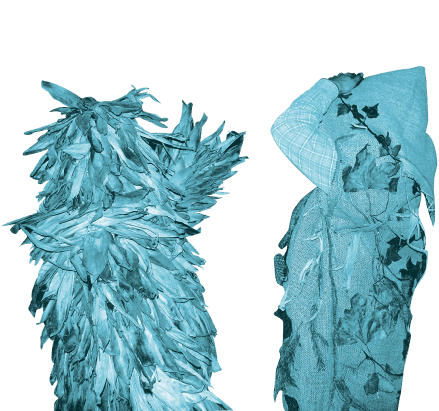
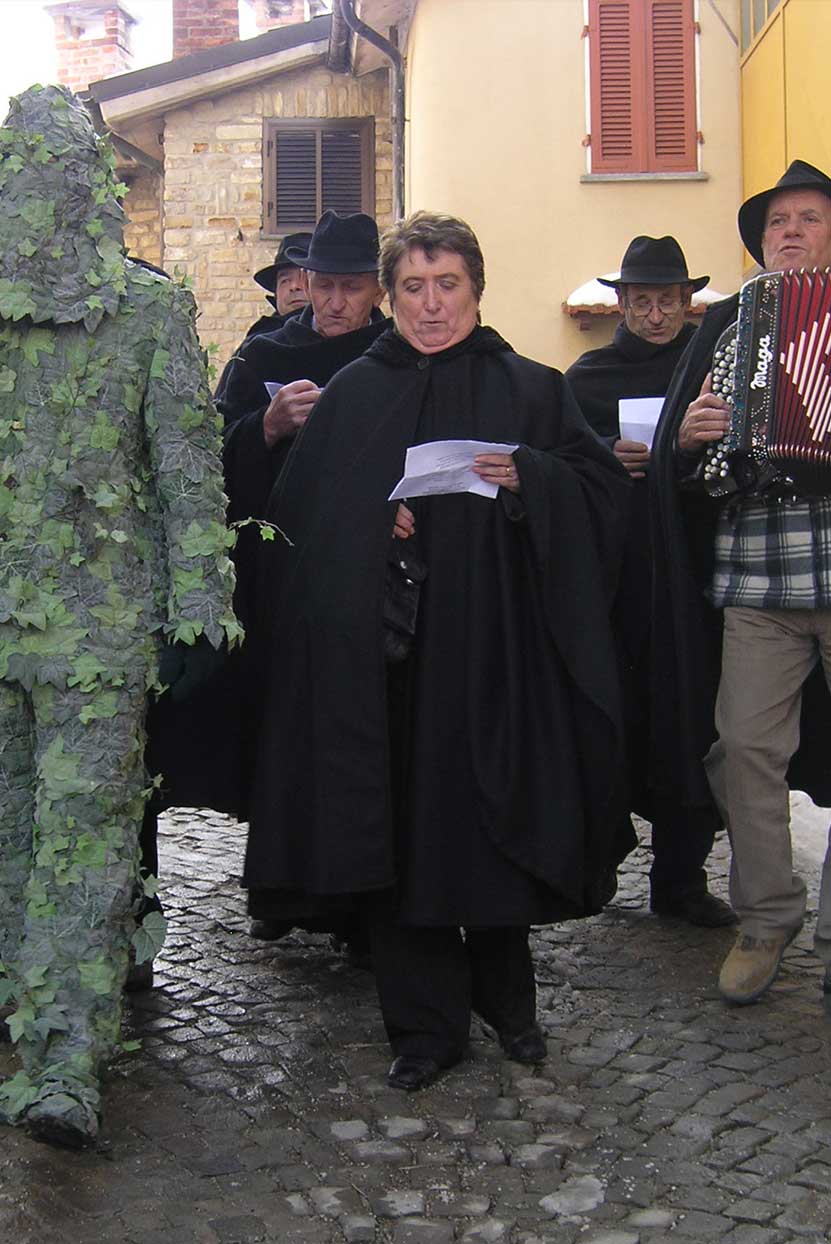
The Ethnic Figure of the Sfoiass Bear, Dressed in Dried Corn Leaves
The farm calendar schedules feast days in the brief period between the end of July and mid-August, when the wheat has been harvested and there is little to do but wait for the next crops to ripen in early autumn. What are the local rhythms of the traditional feasts that delineate the identity of these hills?
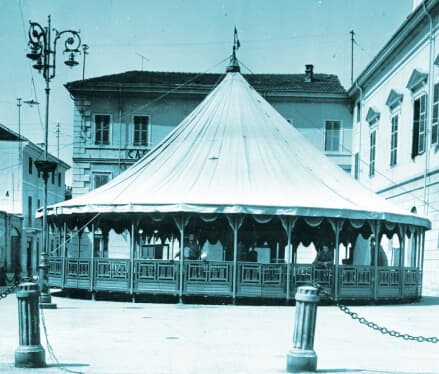
The big tent dances, at which until a few decades ago a “select orchestra” performed, have survived to the present day and made their return in the central piazzas of small towns.
The bonfires go further back, to more primitive rites. In The Moon and the Bonfires, Cesare Pavese evokes the mythical, sacrificial, purifying presence of fire in the rural world. Fire also served to protect the vineyards and the orchards from spring frosts. To fight phylloxera, with the same thought in mind, the farmers would make bonfires next to the vineyards, and invoke the fire’s magical purifying powers when they leapt over the flames, to sterilize the clothing they had worn while working between the rows, as well as the tools they had used, so as to avoid spreading the disease.
The second day of February, the Christian feast of Candelora (Candlemas), is one of the most important ritual occasions of the year. Legend has it that during that night, the hibernating bear wakes up and emerges from its cave. Depending on the stage of the moon, it then decides whether to go back to sleep or stay awake. Farmers would observe these ancient signs to decide when to stop gathering in their stables for the winter wakes and when to begin working in the fields.
Along with the bear, in our study area, the goat is the protagonist of a rich vein of folklore, especially around Asti. When a younger sister married before her older sister, it was a common jibe to bring a goat to the wedding celebration, to symbolize that the natural period of matrimonial hopes had expired, and the unmarried older girl was now on the market, just like any old goat.
The traditional feasts that mark the Piedmont calendar are defined and collected in an institute devoted to preserving folklore: la Badia, or Abbadia. It is an association of young people whose mission was, and in part still is, as written in its bylaws, to observe, respect and share the words of the myths and rites on the occasion of festive community events.
Singing for eggs: young people dedicate the forty days of Lent that lead up to Easter week to singing for eggs. It is a folk song: opening up the windows because spring is at the door is the anthropological gift and return gift that the young people of the community act out. The gift is the Lenten choir that augurs a fruitful year, while the counter gift are the fresh eggs that the woman of the house has put aside and gives to a young man dressed as a monk.
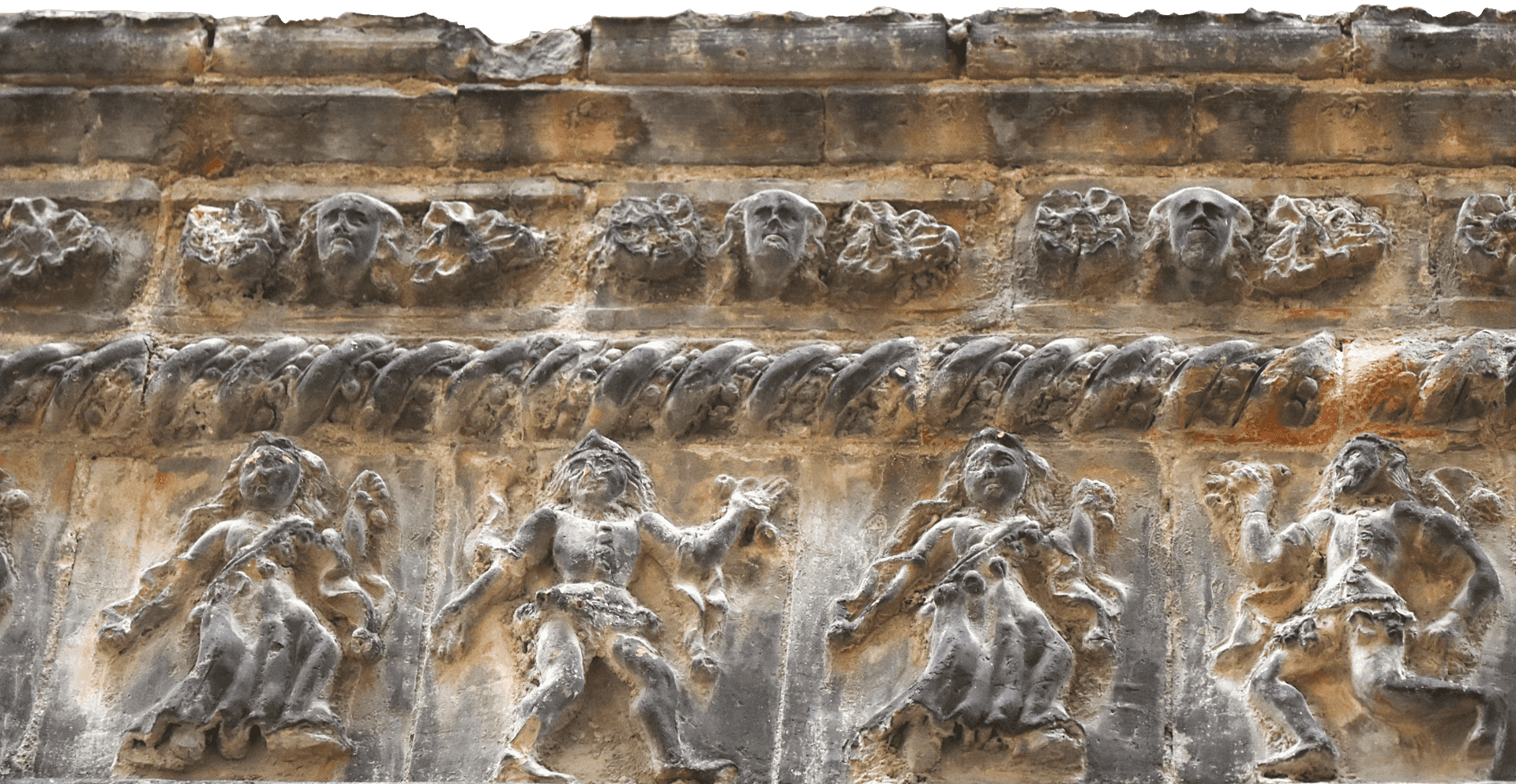
15th-century frieze marking the levels of a house - Casa Do, Alba (Motif between one floor and another)
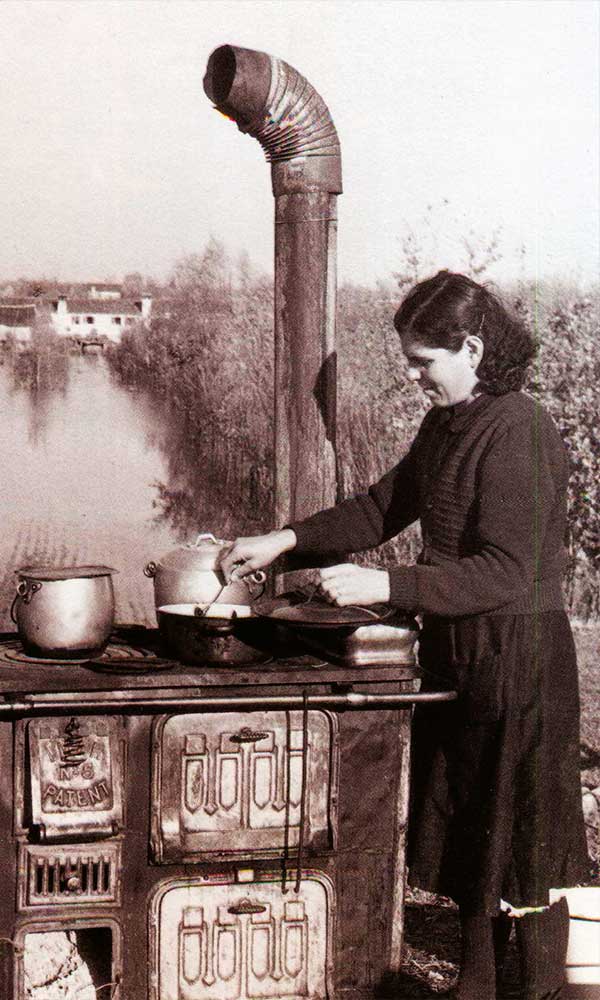
Addomesticazione del fuoco selvaggio
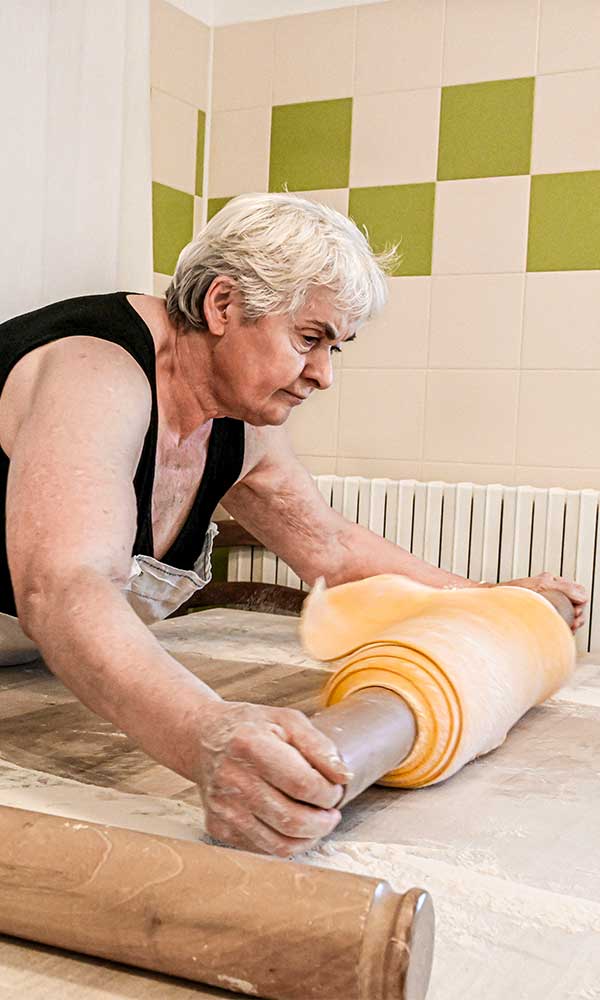
Gemma Boeri
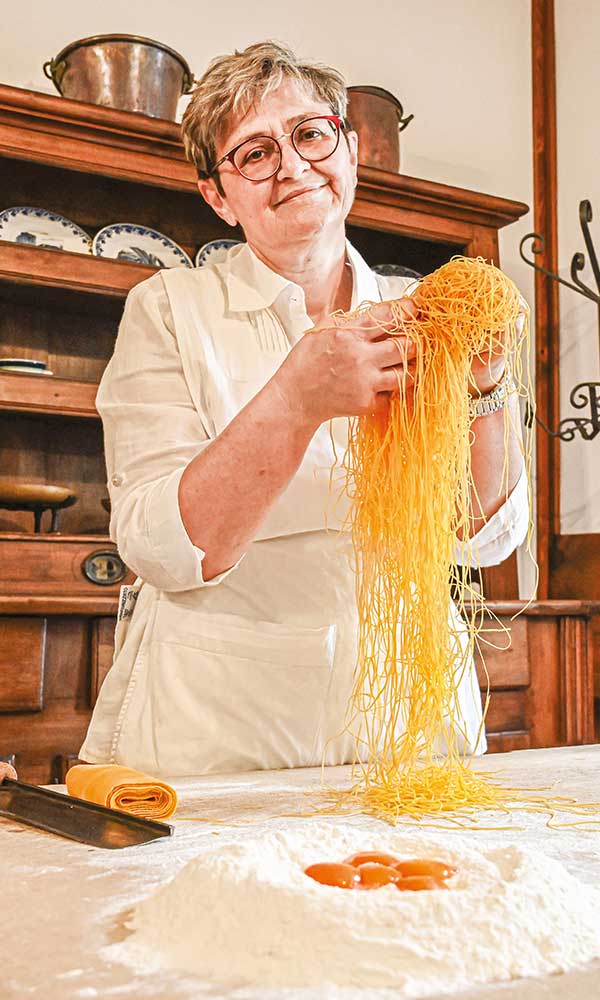
Tajarin, Trattoria della Posta da Camulin
Women and Cuisine: The Origins
It is in the kitchen that the most extraordinary combinations of the products of this land are concocted, thanks to the talent of the women who have made the area’s gastronomy unique. The woman of the house was responsible for putting lunch and dinner on the table, or in the trough if she was feeding the animals, all working with just a wood fire. However, this did not keep the exceptional local products from being prepared properly, and thus contribute to a more elaborate style of cooking.
That is why our young women were more in demand than those from other parts of the countryside.
A menial job that could sometimes become an opportunity for cultural exchange, when the young woman was able to combine her simple country cook’s know-how with the more refined tastes and techniques of the city, when the straightforward manual skills of peasant cuisine encountered the more complex urban style and the oral memory of food preparation gave way to written recipes.
We have a precious ethnographic document of this small yet giant step, once more thanks to the inquiries of Paul Scheuermeier.
- Ravioli al Plin – These little handmade raviolis call for special dexterity on the part of the woman preparing them, especially when she folds the thin pasta to enclose the filling. Ravioli al plin are a clear and evident example of how oral and manual know-how is handed down from one generation to another.
- Tajarin – Local legend has it that tajarin were first invented in Cossano Belbo, and they say it is the water there that makes the difference. A skill that was not lost because the women of the house have always taught their children how to cook, and the ancient job of cutting mountains of tagliatelle by hand is basic.
- Bunet – Bunet is a pudding made with eggs, unsweetened cocoa, dried amaretto cookies, dark coffee, dry marsala and Fernet, which was served as a digestive after a heavy meal.
- Friciule – A simple concoction made from bread dough that was not taken to the town oven to be baked. In the winter, when sudden blizzards made it impossible to bring the dough to the baker, it would be smoothed out in little circles by hand and fried in a pan.
- Bagna cauda – An ethnic dish that may come from the vegetable patches in the valleys between the hills. The Nizza Monferrato cardoon, is the most prized vegetable in the assortment, to be dipped in a sauce cooked at length over a low flame, containing garlic, anchovies and olive oil. The most socially inclusive and yet the most controversial dish we know.
- Polenta – Polenta has kept peasants from going hungry for centuries: it is a ritual food during the winter months and in the early spring.
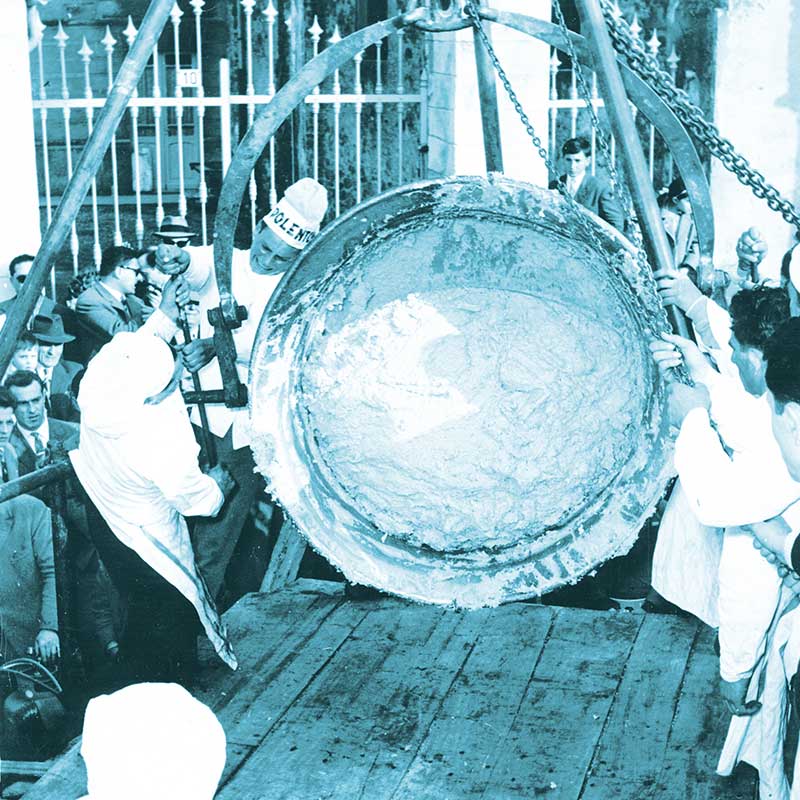
The polenta feast in Ponti, in the Bormida valley
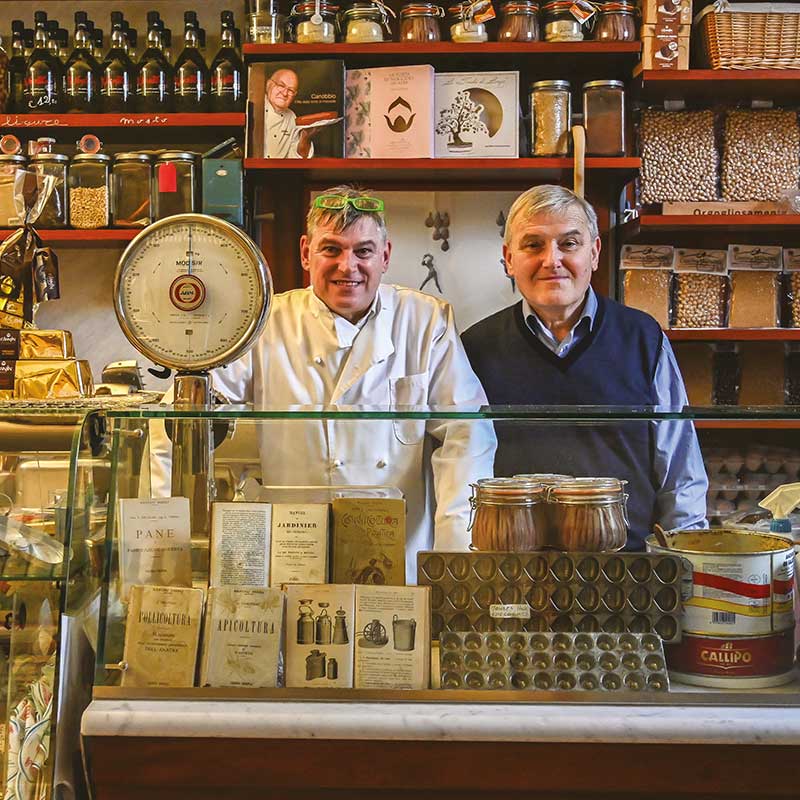
Censa dell'Osteria del Peso
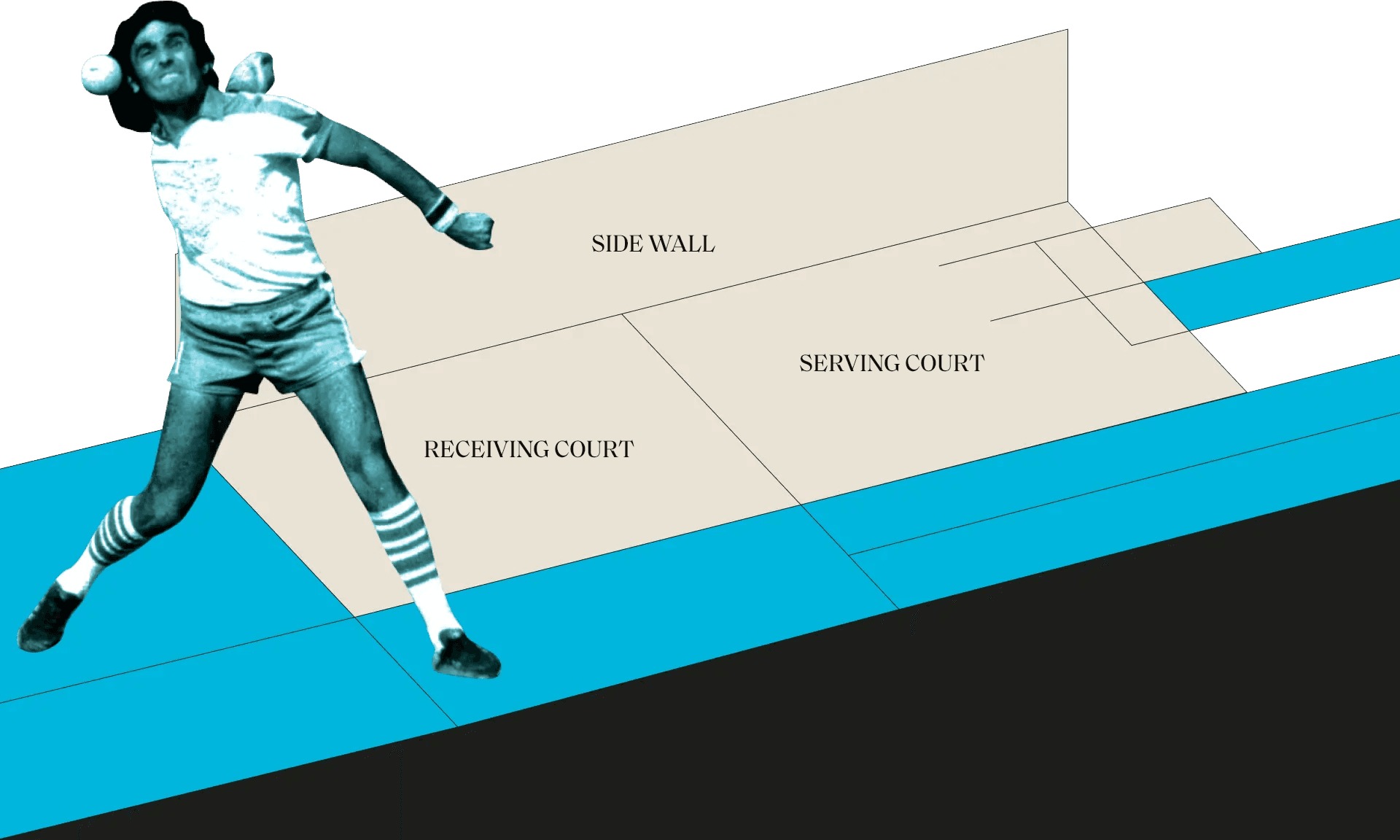
The Resistance, Fistball and Cuisine
It was mostly in the high hills that young people found a true, like-minded community to join, hospitable and willing to share the dangers of wartime and their scarce stocks of food.
Up here the farmers build strong, tall stone walls, terracing the hillsides to carve out little strips of land stolen from the slopes, fragments that trace a web of survival as well as a social network, lending a sense of profundity to life in the hills. In the same way, in the high hills the game that most celebrates local identity and culture, fistball, is played in the most inaccessible places, in conditions that present-day athletes would regard with scorn.
At the End of It All
The high and the low: a landscape, a motherland that cannot live without both, because they are by nature indivisible and give rise to a single, unique ocean of hills in a large area of southern Piedmont.
Right atop the high hills of the Belbo and the Bormida, two anthropomorphic stone stelae were found, upright columns supporting a vineyard planted at the time of the phylloxera infestation.
Recently, Nando Gallo, a young stonemason, has reconstructed pairs of columns that duplicate the originals, which are being used in a new vineyard on Fontanafredda’s Mirafiore estate in Serralunga d’Alba.
The high hills, with their rare, profoundly generous soils, offer much and ask for little in return beyond respect for what they are, a poetic natural universe in which to cultivate the best of our humanity.
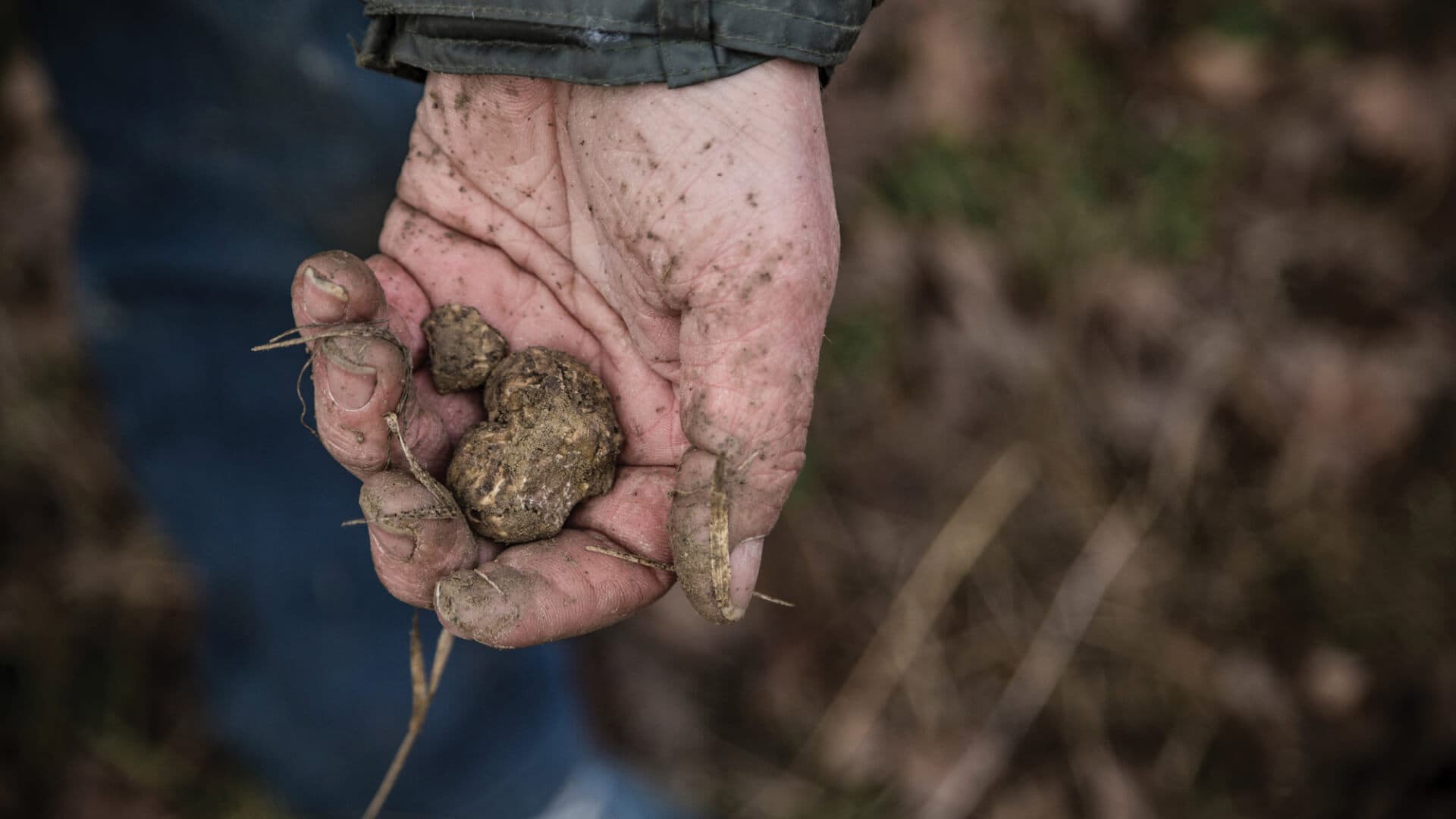
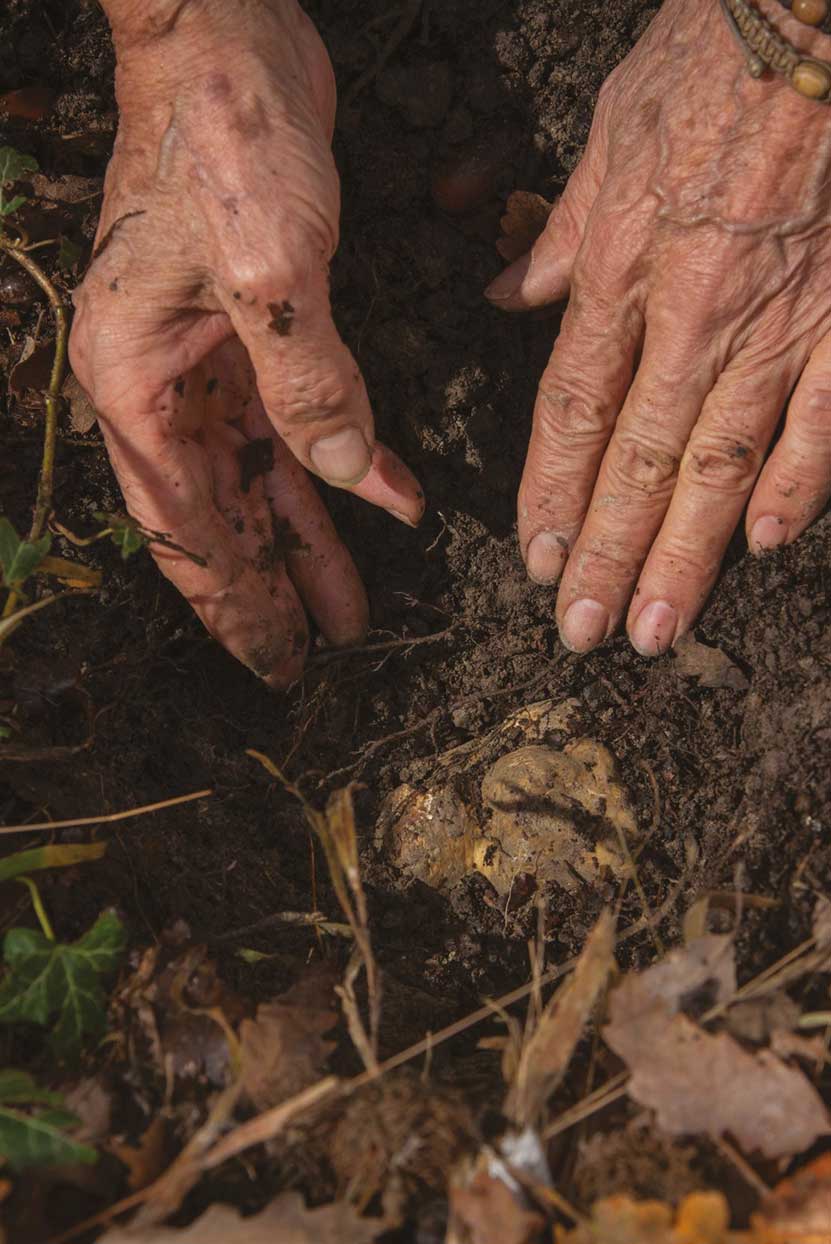
Alta Langa and Alba White Truffles
Next page: